Last year, Metro Water District (District) provided customers with a notification regarding service line investigations that are part of the United States Environmental Protection Agency (USEPA) requirements to comply with the Lead and Copper Rule Improvements. This year the District investigated an additional 3,700 service lines throughout the District. This information is used to create an inventory of the service line that brings water from the watermain to the customer premises.
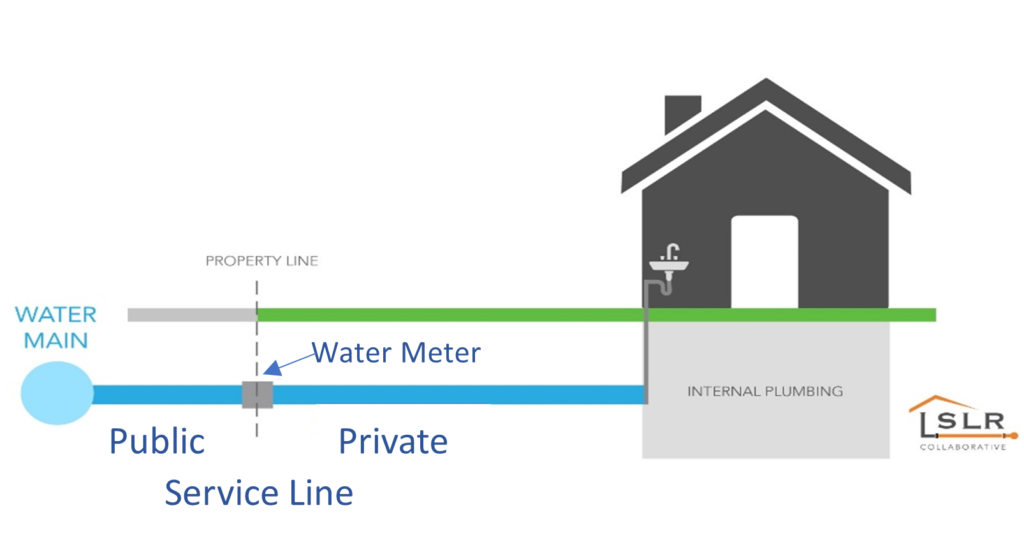
To accomplish this inventory, we have uncovered portions of the service line on both the public and private side (see graphic below) to visually verify the material of the service line. To date, we have performed thousands of potholes (small excavations) throughout our service areas in order to visually determine the service line material at 7,400 addresses. None of these service lines were lead and it is not anticipated that we will find lead service lines as we complete the physical service line inventory. Also, lead was no longer used in service lines constructed after July 1988. In other words, we have already verified that over 13,700 out of the approximately 21,000 service lines throughout the District are not constructed of lead. The District is committed to performing the remaining 5,300 physical identification of service line materials by November of 2027.
Service lines installed prior to July 1988 are considered as “unknown” until the physical inventory is complete. The USEPA requires that all water providers inform customers that have a service line that has yet to be identified, along with the information shown below. While completion of the physical inventory of “unknown” service lines ongoing, it is highly unlikely that any material will be determined to be lead, though a physical inventory will be performed with “unknown” service lines in accordance with the schedule established by the USEPA.
To see a map of the status of the Metro Water’s service line inventory, please visit the link below associated with your individual District Service Area. You can utilize the search function on the map to quickly identify your address or use the scroll feature. This website will be regularly updated as the District works toward completing the service line inventory.
Metro Main Service Area
Metro Hub Service Area
Metro Southwest – Diablo Village Service Area
Metro Southwest – E&T Service Area
Metro Southwest – Lazy B Service Area
The above links will open a separate tab to the third party 120water.com website for managing service line inventories for compliance with the USEPA LCRR requirements.
While the District has not identified any lead service lines, and water quality testing is accomplished per the Lead and Copper Rule Revisions, the USEPA has provided the following additional information regarding the health effects of lead and proactive steps for concerns of lead in your water.
EPA Required Resource Information:
Exposure to lead in drinking water can cause serious health effects in all age groups. Infants and children can have decreases in IQ and attention span. Lead exposure can lead to new learning and behavior problems or worsen existing learning and behavior problems. The children of women who are exposed to lead before or during pregnancy can have increased risk of these negative health effects. Adults can have increased risks of heart disease, high blood pressure, and kidney, or nervous system problems.
The USEPA has developed a “Protect Your Tap: A Quick Check for Lead,” which is available at: https://www.epa.gov/ground-water-and-drinking-water/protect-your-tap-quick-check-lead.
Below are recommended actions that you may take, separately or in combination, if you are concerned about lead in your drinking water. The list also includes where you may find more information and is not intended to be a complete list or to imply that all actions equally reduce lead in drinking water.
Use filters properly. Using a filter can reduce lead in drinking water. If you use a filter, it should be certified to remove lead. Read any directions provided with the filter to learn how to properly install, maintain, and use your cartridge and when to replace it. Using the cartridge after it has expired can make it less effective at removing lead. Do not run hot water through the filter. For more information on facts and advice on home water filtration systems, see EPA’s https://www.epa.gov/water-research/consumer-tool-identifying-point-use-and-pitcher-filters-certified-reduce-lead.
Clean your aerator. Regularly clean your faucet’s screen (also known as an aerator). Sediment, debris, and lead particles can collect in your aerator. If lead particles are caught in the aerator, lead can get into your water.
Use cold water. Do not use hot water from the tap for drinking, cooking, or making baby formula as lead dissolves more easily into hot water. Boiling water does not remove lead from water.
Learn about construction in your neighborhood. Contact us at 520-575-8100 to find out about any construction or maintenance work that could disturb your service line. Construction may cause more lead to be released from a lead service line or galvanized service line if present.
Please share this information with your neighbors and, if you have any questions, please contact the District at 520-575-8100.